Showing posts with label Gold. Show all posts

Friday, May 22, 2009

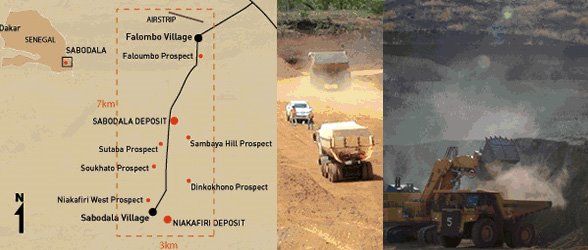
More than One Tonne of Gold Poured at Sabodala

More than One Tonne of Gold Poured at Sabodala

Top Mining News : This is an information of the achievment of "The Sabodala Gold Mine" in producing Gold mine in Africa especially in Sinegal. Read the information below:

Mineral Deposits Limited announce that over one tonne of gold (32,151 ounces) has been poured at the Sabodala Gold Mine in Senegal, west Africa since start-up of full production in early April. This milestone is a credit to the entire team at Sabodala.

The plus US$220 million project is now processing material above the nominal mill capacity of 2 million tonnes per year.

“The Managing Director, Jeff Williams, said the one tonne milestone is a tremendous achievement for all shareholders and has set the foundation for 2009 and beyond.”

The company expects to produce 160,000 ounces in calendar 2009 at a cash operating cost of between US$420-440 per ounce.

The Sabodala Gold Mine is operated through Sabodala Gold Operations SA which is 10%-owned by the Government of the Republic of Senegal and 90%-owned by MDL.

Friday, April 3, 2009

Lajitas Gold Project in Northern Chile.

Lajitas Gold Project in Northern Chile.
Top Mining News : This is the news on Capella which Drills 261 Metres Grading .91 G/T Gold at Lajitas. Th complete news is as follows

Capella Resources Ltd. announce drill results (drill hole LJ-08011) from the Company’s 100% own Lajitas gold project in northern Chile. The core drilling intersected a zone of continuous gold mineralization of 261 meters grading 0.91 grams per tonne (g/t) gold between 90 meters and 351 meters down the hole. Contained within the intersection is 104.7 meters grading 1.59 g/t gold.

LJ-08011 was drilled at a -60 degree angle into an induced polarization (IP) anomaly that is 1.8 kilometres in diameter on the southeast edge of a non-compliant 43-101 historic gold resource, which was calculated by Minera Santa Fe Pacific Chile Ldta. in 1997.

The entire mineralized drill intersection noted above is contained within oxidized andesitic volcano-clastic and dacitic intrusive rocks that are variably altered with iron oxides, clay, and silica. Rocks at the Lajitas gold project exhibit some of the deepest oxidation known in the Maricunga District.

Anomalous copper mineralization was intersected throughout drill hole LJ-08011 with the best interval grading 0.15% copper (Cu) over 33 metres between 294 and 327 metres down the hole. Additionally, significant ground water was intersected in the Lajitas gold project drilling. During the past year the Company has conducted extensive title research of the water rights over the Lajitas gold project and is preparing application for those surface and sub-surface water rights.

The Lajitas gold project is located approximately 12 kilometres southeast of the Marte-Lobe gold deposit that was recently acquired by Kinross and lies 18 kilometres east of Andina Minerals’ Volcan gold deposit. The Lajitas gold project is subject to a 5% net smelter return royalty and the Company has the option to reduce the same to 2% by paying the royalty holders a cash payment of US$3,000,000.

Thursday, December 11, 2008

Advances in Gold Ore Processing,Volume 15 (Developments in Mineral Processing)

Advances in Gold Ore Processing, Volume 15 (Developments in Mineral Processing)

"The book should be of great use to mineral processing engineers, metallurgists, process mineralogists, mining engineers, environmental engineers, consultants, plant managers, and students. It is certain that it will be the source book for those working in the field for decades to come. I consider this is the Book of the Year!"

Biogeochemical, Health, and Ecotoxicological Perspectives on Gold and Gold Mining

Biogeochemical, Health, and Ecotoxicological Perspectives on Gold and Gold Mining

Despite the esteemed nature of gold in society, evidence of adverse ecotoxicological effects and risk to human health in various mining and extraction techniques has generated increasing interest in the biological and environmental implications of gold. Biogeochemical, Health, and Ecotoxicological Perspectives on Gold and Gold Mining is the first comprehensive book to evaluate the effect of gold production and use on human health as well as the environmental impact of gold mining and extraction.

Dr. Ronald Eisler, a well-known senior research biologist and expert in the chemical and biological effects of various compounds on wildlife, provides a thorough risk assessment of gold, including its geology and sources and physical, chemical, and metabolic properties. The author documents gold concentrations and field collections of abiotic materials and biota and presents research on the lethal and sublethal effects of gold on plants and animals. Supported by case histories, the book examines health risks in gold miners, human sensitivity to jewelry and dental implants, and medicinal uses. It uses examples in several countries to thoroughly explore the environmental effects of gold extraction, including tailings disposal, acid mine drainage, cyanide, arsenic, and mercury contamination, water management issues, and abandoned mines. Unlike traditional risk assessments, the author also takes into account social, political, economic, medicinal, and psychological variables for a more complete perspective on gold's impact on health and the environment. Biogeochemical, Health, and Ecotoxicological Perspectives on Gold and Gold Mining concludes with a discussion on mining legislation, safety, and procedures.

Gold Mining Together

Gold Mining Together

Gold mining is a great way to spend time outdoors with friends and family. This book gives you everything that you need to start this exciting hobby right now. Who knows, maybe you will strike it rich. Here is a list of the chapters: - Togetherness - Looking For Gold - Background of Gold Mining - Panning For Gold - Sluice Boxes & High Bankers - Dredging - Dry Mining & Dry Washing - Sniping & Crevicing - Gold Mining Activities - Glossary of Terms Order today and start enjoying gold mining now!

Review : By G. Garcia "Gold Digger"

OMG, I never knew there were so many ways to find gold. Using the tips from this book allowed my family to go out with our gold pans and find Gold. I would never have known where to look but with Jeff's advice we were able to go to the right spots. We are hooked!! Thank You so much for making this book so easy to follow.

Monday, November 10, 2008

Zimbabwe: 5000 Lose Mining Jobs As RBZ Fails to Make Gold Payments

“Daily updated mining exploration news on gold”—–Zimbabwe’s largest gold mining exploration firm has stopped operations at its five mines across the country, resulting in 5,000 people losing their jobs and officials laying the blame squarely at the door of the Central Bank.

The Reserve Bank of Zimbabwe (RBZ) has recently come under severe scrutiny after international donor group, Global Fund, announced that more than US$7 million in donations had been diverted by the central bank for other purposes. The group suspended future grants to Zimbabwe until the money was repaid, a move which immediately saw the central bank come up with the millions that were repaid on Friday.

But the bank will now have to answer for the closure of Metallon Gold’s five mines, after officials said this week’s closure resulted from long delays receiving payments for gold delivered to the RBZ.

“We have no mine which is operating at the moment,” Metallon Gold’s CEO Collen Gura said on Thursday. “We cannot continue to produce when we are not getting paid, so there are no operations at any of our mines across the country.”

Metallon Gold, which produces 40 percent of the country’s gold output, is owned by South African mining mogul Mzi Khumalo. According to the Chamber of Mines, Zimbabwe’s gold production plunged by 61 percent in March, compared to February this year, while the country’s average monthly gold production has declined from more than two thousand kilograms in 1999 to a mere 267kgs this year. Gold has traditionally been one of Zimbabwe’s main foreign currency earners, but the mining sector has been crippled in recent months by power cuts, shortages of foreign currency and the exodus of experienced personnel.

At the same time Zimbabwe’s central bank apparently owes gold producers US$30 million, dating back to end of 2007.

“The failure by the RBZ to pay for gold delivered to it has decimated the entire gold industry,” the Chamber of Mines said in a statement released Thursday.

Political analyst Professor John Makumbe from the University of Zimbabwe on Friday said the country’s central bank “has a lot to answer for and be held accountable to.” Makumbe said the mine closures are a serious threat for the country’s future “not just because of the loss of jobs but also because of the devastating effect this will have on the already fragile economy.”

Makumbe also argued that the mine closures mean that rebuilding the country will take even longer, because of the time and money needed to reopen mines.

“The Mugabe regime can ignore the crisis as they are doing,” Makumbe said. “But at the end of the day it will be many years to come before Zimbabwe can be repaired.”

Canadian Mining Exploration Company says Higher quality gold, silver deposits found in SC

“Daily updated mining exploration news on gold”—–HIGHER quality gold and silver deposits have been uncovered at a mining area in T’boli, South Cotabato, a Canadian mining exploration company said.

Cadan Resources Corp., which operates the Tboli gold-silver project through Philippine affiliate Tribal Mining Corp., announced recently that a new underground vein sampling possibly contain resources of 584,000 tons at 10.2 grams per ton gold and 50 grams per ton silver.

What’s your take on the Mindanao crisis? Discuss views with other readers

In September, the mine area’s inferred mineral resources stand at 420,000 ounces of gold and 1.6 million ounces of silver. It pegged the grade at 5.5 grams per ton gold and 21 grams per ton silver.

“The latest higher grade results continue to indicate that the T’boli gold-silver resource not only appears to be larger in area but also the grade appears to be higher than that of the NI 43-101,” said Edgar D. Martinez, Tribal Mining president, referring to the September resource estimate.

In a statement, he noted that within this 400-meter strike length, “there has been no drilling but only minimal surface exploration activity.”

However, results of previous assays on the eastern side of the resource ranged from 13.37 g/t gold to a high of 81.14 g/t gold, Martinez added.

Tribal Mining was given approval by the Philippine government to continue its exploration activities last September 9 for potential development of the T’boli gold-silver project.

Cadan, previously known as Sur American Gold Corp., began underground development of the T’boli gold-silver deposits sometime later to determine higher quantity and quality of the mineral resources in the area.

The company’s mine development site straddles an area earlier contested by a native clan and a local cooperative.

The Maguan clan has sought clearance to mine the area of the T’boli Minahang Bayan Multi-Purpose Cooperative, which the clan contended forms part of their ancestral domain claim.

Consisting of small-scale mining operators, the cooperative had earlier asked a local court that 21 hectares of gold-rich portion of Barangay Kematu in T’boli town be appropriated for their exclusive use.

The parcel of land, however, forms part of the 85-hectare mining area granted by the government to Tribal Mining under Mineral Production Sharing Agreement number 090-97-XI.

Constancio A. Paye Jr., Mines and Geosciences Bureau regional director, said the dispute between the cooperative and Tribal Mining is separate from the claims of the Maguan clan.

During the term of then South Cotabato governor Hilario de Pedro III, he issued an executive order apportioning the 21 hectares as “minahang bayan” or “people’s mining site” to address the row between the cooperative and Tribal Mining.

Paye said that an estimated 20 to 30 tunnels had been developed by cooperative members at the “minahang bayan” site over the years.

Venezuela Tries to Offer Russians Big Gold Projects

“Daily updated mining exploration news on gold”—-CARACAS — Venezuela plans to build mines at its largest gold deposits with Russian help, the mining minister said on Thursday, apparently killing a years-long bid by two Canadian companies to develop the projects.

The decision reflects leftist President Hugo Chavez efforts to boost ties with Russia, increase state control over a key sector and speed up stalled mining development as tumbling crude prices threaten to crimp the OPEC nation’s finances.

An accord will be signed on Friday with Russian-owned Rusoro to operate the Las Cristinas and Brisas projects with Venezuela, mining minister Rodolfo Sanz told a Russian government delegation during a presentation observed by Reuters. Rusoro’s share price soared after the news.

Las Cristinas, one of Latin America’s largest gold projects, is currently operated by Canada’s Crystallex, which waited in vain for years for an environmental license to start mining.

Nearby Brisas is operated by Gold Reserve, which has a concession for the mainly gold project but was also waiting for environmental permits.

While it appeared that Sanz will replace Crystallex and Gold Reserve with Rusoro, he did not mention their names.

He said the memorandum would not mention Las Cristinas and Brisas by name for legal reasons but assured the Russians they would have access to the projects.

“You can be sure that those will be the deposits,” he told the delegation.

“We have to rescind our relationship with a company that has been working in the zone,” Sanz also said, apparently in reference to Crystallex. “We have a legal problem there.”

Approached after the presentation by Reuters, Sanz said Rusoro’s involvement in Las Cristinas had not yet been decided.

The statements came a day after Venezuela, which frequently warns against building reserves in U.S. dollars, said it wanted to recover control over its gold to boost its gold reserves as a shield from global financial crisis.

Chavez in recent years has wrested control from the private sector of the oil, electricity and telecom industries.

Rusoro’s stock jumped by as much as 38 percent to C$0.65 following Thursday’s news, while shares of Crystallex edged down. Gold Reserve shares were up slightly.

A Crystallex spokesman told Reuters that Venezuelan officials have said the project remains on track. A Rusoro spokesman did not comment on the situation but said CEO George Salamis was on his way to Venezuela.

Guv Closes 145 ‘illegal’ gold tunnels

“Daily updated mining exploration news on gold”—- The South Cotabato Provincial Government has clamped down on alleged illegal small-scale mining players in T’boli town, closing down some 145 tunnels and serving stoppage orders to 17 ore processing or ball mill operators.

Lourdes S. Jumilla, Provincial Mining Regulatory Board secretariat chief, said that dozens of policemen and soldiers under the 27th Infantry Battalion helped serve the closure order against the mining tunnels on Wednesday.

What’s your take on the Mindanao crisis? Discuss views with other readers

The closed gold mining tunnels cover an area of 21 hectares in Barangay Kematu, an expanse disputed by the native Maguan clan and the T’boli Minahang Bayan Multi-Purpose Cooperative (TMBMPC).

“These operators failed to get mining permits from the Provincial Government despite given enough time already,” Jumilla said.

Governor Daisy P. Avance-Fuentes said she ordered the closure of illegal small-scale operations months ago on the recommendation of the provincial mining board.

Jumilla said the stoppage order should have been implemented months ago but the Provincial Government deferred it in the hope that the Maguan clan and the cooperative settle their differences.

The application of the Maguan clan to mine in the 21 hectares, which they insisted forms part of their ancestral domain claim, was denied by the Provincial Government, Jumilla said without elaborating.

On the other hand, the cooperative failed to present a Free Prior Informed Consent certification from the tribe, she added.

The cooperative members are mining the 21 hectares for years and they were given three months starting last June to secure the necessary permit but they did not, thus we finally implemented the order of the governor, Jumilla said.

But she said the small illegal mining players will be allowed to resume operations if they can secure permits from the Provincial Government.

The parcel of land, however, forms part of the 85-hectare mining area granted by the government to Tribal Mining Corp. under Mineral Production Sharing Agreement number 090-97-XI.

Canadian mining exploration firm Cadan Resources Corp. recently confirmed high-grade gold and silver deposits in the area of Tribal Mining, its Philippine affiliate.

Jumilla said the settlement of the case between the cooperative and Tribal Mining is still pending before the Court of Appeals (CA).

Meantime, Ali S. Pantao, lawyer of the regional Mines and Geosciences Bureau, said they received a copy from the Provincial Government stopping the operations of ball mill plants also in T’boli town.

Jumilla said they serve closure orders to 17 ball mill operators in the town still mired in poverty despite being known as a gold rush site since the 1980s.

They lack environmental clearance certificates but some of them are now trying to comply with the necessary requirements, she added.

There are around 50 ball mill plants in the town, some of them in residential areas, which the local government would like to transfer to a designated industrial zone, Jumilla said

Sweeping changes in AngloGold Ashanti, Gold Fields and Harmony

“Daily updated mining exploration news on gold”—-The new brooms at Africa’s biggest gold producers - AngloGold Ashanti, Gold Fields and Harmony - have had a lot of sweeping to do in a fast-changing industry. Some have swept cleaner than others.

The aggressive way AngloGold CEO Mark Cutifani tackled the company’s hedge book (selling gold forward at a fixed price to reduce risk) is impressive. When Cutifani took over from Bobby Godsell in October last year, the firm had about 10,6m oz of gold hedged. This meant AngloGold was selling its product for less than the spot gold price. By the end of September the hedge book stood at 6,3m oz, and the company plans to reduce this to 6m oz by the end of 2008.

Australian-born Cutifani has also gained significant ground on the safety front. The June quarter was the first in AngloGold’s century-long history that a worker did not die in its mines, which are among the deepest in the world. Cutifani insists AngloGold can eliminate deaths, but Afrifocus Securities analyst Mark Madeyski says this is not possible because of the risks associated with mining such as deep and narrow ore bodies.

Another analyst, who can’t be named because of his company’s policy, says Cutifani has delivered on all his promises, particularly on production.

The other gold major that’s experienced a makeover since its leadership change is Harmony. Graham Briggs took the reins from 12-year veteran Bernard Swanepoel in August 2007. Swanepoel had quit abruptly, leading to a 30% drop in the share price in just two days. From the start, Briggs emphasised Harmony was returning to its “back to basics” mining approach.

Briggs, a geologist, has succeeded on this front, controlling costs and upping production. He has also engineered deals involving Harmony’s uranium and Papua New Guinea (PNG) assets. Both transactions have added value to the group. In PNG, Harmony sold a 50% stake in its Hidden Valley mine as well as exploration targets to Australia’s Newcrest for about US$530m. In December last year, Briggs announced the sale of a 60% stake in its Randfontein uranium dumps and a mine shaft to Pamodzi Resources Fund for $209m.

Both of these transactions bring cash to Harmony’s balance sheet and reduce the amount of capital the company will have to spend to develop the projects by itself. This will allow the firm to slash its net debt from R2,4bn at the end of September to R224m by mid-2009. That puts Harmony in a good position, given the uncertain credit environment.

“I think Briggs has done quite well, given what he’s got to work with,” says Madeyski, referring to the fact that Harmony’s mines are older and of a lower quality than its competitors.

The other new appointment in the sector is Nick Holland, who took over as Gold Fields CEO from Ian Cockerill on May 1. His first day on the job was a baptism of fire: nine workers plunged to their deaths at Gold Fields South Deep mine after a rope snapped. Since then, Holland has focused on improving the group’s safety performance.

“I don’t think he’s achieved much yet,” says Madeyski. He does, however, acknowledge Holland has had less time at the helm to effect any changes than Briggs and Cutifani.

What does stand in Holland’s favour is that the chartered accountant has tackled the Gold Fields safety record head-on. His actions include the six-month closure of the main shaft at the company’s key Kloof mine for repairs, costing the company 500 kg/month of gold. Though this brings about short-term production pain, it sets the company up for less safety-related stoppages in the future. The anonymous analyst adds that many of Gold Fields safety problems are a legacy left by previous management, and Holland has been left “to pick up the pieces”.

Out of the three CEOs, Madeyski picks Cutifani as the winner: “He knows what he’s doing, I’m impressed with him.” The unnamed analyst agrees, saying: “AngloGold’s a completely different ship; there’s a whole different vibe there.”

The markets, however, have favoured Briggs, with Harmony’s share price having fallen less than the other two. It slid 38% from a high of R118,50 to R72,97 this week. But this is skewed by the fact that Harmony’s stock came off a low base after dropping drastically in August 2007, following a production forecast cut and Swanepoel’s resignation. AngloGold has lost 47% from its 12-month high of R349 to trade at R182,39/share. Gold Fields fell the most, giving up 52% of its R137,40/share 12-month high to trade at R65.

Sunday, October 26, 2008

The U.S. $ 1.9 million Repayment of Apollo Gold Corporation

DENVER — Apollo Gold Corporation announces that it has prepaid U.S. $ 1952000 of U.S. $ 4789000 remaining balance of the under facilities agreement with RMB Australia Holdings Limited ( “RMB”) of the proceeds of unwinding of its hedge position more fully described below.

On 12 October 2007, Apollo entered into U.S. $ 8000000 facility agreement (the “Facility Agreement”) by and between Apollo and its wholly owned subsidiaries, Montana Tunnels Mining, Inc. and Apollo Gold, Inc., that borrowers and guarantors, and RMB as a lender. The facility agreement has been fully reimbursed by Apollo in 2008 with the last installment payments are made in August 2008.

On 1 July 2008, Apollo has entered into an amendment to the facility agreement (the “Amendment”) and borrowed an additional U.S. $ 5,150,000 (the “credit facility extended”) and entered into put and contracts ( “contracts”) for gold, silver, lead and zinc as a requirement of the amendment. As of September 30, 2008, the balance of the facility was extended loan of U.S. $ 4789000 .

On 23 October 2008, Apollo held part of the contracts in early debt management since the decision of the present value of some contracts exceeded the December 2008 repayment obligation (U.S. $ 1717000) in the context of the Credit extended and products in U.S. $ 2010000 were applied as follows:

1. Repayment of principal $ 1,952,000
2. Interest at December 31, 2008 $ 49,300
3. Costs $ 8600

As of October 23, 2008, and after giving effect to prepay U.S. $ 1952000 described above, must Apollo U.S. $ 2837000 million expansion under the loan facility. This operation has no effect on other terms of the amendment.

As of October 23, 2008, Apollo has the following and pending contracts.

Put call
Price Price
$ $
GOLD Jan-09 OZS 977 800 1,075
Feb-09 OZS 977 800 1,075
Mar-09 OZS 977 800 1075
Total 2931

SILVER Jan-09 OZS 8,262 16.25 18.8
Feb-09 OZS 8,262 16.25 18.8
OZS-09 March 8262 16.25 18.8
Total 24,786

Lead Jan-09 Lbs 372,476 0.775 0.835
Feb-09 Lbs 372,476 0.775 0.835
Mar-09 Lbs 372,476 0.775 0.835
Total 1,117,428

Apollo Gold Corporation

Apollo is a gold mining and exploration company that operates the Montana Tunnels Mine, which is a 50% joint venture with Elkhorn Tunnels, LLC, in Montana, the Black Fox advanced stage development projects Ontario, Canada, and the Huizopa project, an early stage exploration project in the Sierra Madres of Chihuahua, Mexico.

Monday, October 13, 2008

The investment of Gold

I have never believed gold is an investment. My definition of an investment is it must generate income - shares in companies generate profits and dividends, property gives rental income and deposits give interest.

Gold does not give income - the only way people can profit is to buy it speculating on an increase in value.

Nevertheless, gold does have its uses. Firstly, it can work as a reasonably good hedge against inflation. Gold is supposed to have “real” value which holds its spending power even when paper money does not.

While gold has sometimes hedged inflation well, it is not a panacea against inflation - at times inflation has been high but gold has fallen in value.

Secondly, gold acts as a “crisis hedge” - in times of political or economic turmoil people hold gold. The idea it has value is nothing more than a long-standing convention and only followed in some societies.

Historically, gold has always had value and when, as now, people do not trust a promise written on a piece of paper, or when there are wars and major dislocations, people can carry their wealth with them in the form of gold, reasonably confident it will have a value.

Advertisement
Advertisement

In the last three years, the gold price has doubled - from US$450 ($748) to US$900 ($1496) per ounce at present.

Among the main reasons for the significant increase has been the number of people troubled by the very high indebtedness of much of the western world and worried about the effects of runaway inflation.

In recent years plenty of people, frightened by the loose credit that has been prevalent, have sought refuge in gold.

The future price of gold will probably follow the ongoing credit crisis - each piece of bad news will see further rises in the value of gold.

Many high net worth individuals have perhaps 5 per cent of their portfolios in gold. These people are not so much speculators, but will hold some gold forever - they will ensure they survive no matter the extent of any meltdown.

It is for this second reason I own a bit of gold.

I favor having it stored somewhere safe, such as in a safe deposit box at your bank.

You can never be sure what economic or political disasters might eventuate in the future.

Owning gold in the form of coins or ingots is different to owning gold “futures” or gold mining companies.

Futures are effectively a promise from someone else that may not be fulfilled, and owning gold mining companies means selecting one with good management, plenty of proven reserves and in a country which is politically stable.

Gold can be bought at the Auckland-based New Zealand Mint, which can also store it.

Wednesday, September 10, 2008

The Chemistry of Gold Extraction

The Chemistry of Gold Extraction

Editorial Reviews
Minerals Engineering, Mineral Processing & Extractive Metallurgy
Highly recommended to hydrometallurgists, students, and engineeers. The authors are to be congratulated for their fine work.

Gold Bulletin October 2006
A very complete book. Highly recommended.


Gold Rush: A Literary Exploration

Gold Rush: A Literary Exploration

Editorial Reviews
From Library Journal
The California Gold Rush, which began in 1848, was a pivotal event in American history, turning the isolated settlements of California into boom towns overnight. Yet the "popular imagination," as editor Kowalewski notes in his excellent introduction, has consistently ignored its significance (perhaps the heady case of gold rush fever is too coarse for our national mythology to incorporate). Kowalewski has compiled the reminiscences of participants in the rush?one cannot call them "miners" because individuals from all walks of life were drawn to the lure of instant wealth?as well as outside contemporary observers such as Twain, Emerson, and Thoreau. First-person narratives give a good sense of those times, from the wealthiest of prospectors to the poorest Chinese immigrant. Since this is the companion volume to the PBS series The Gold Rush, airing in January and narrated by John Lithgow in honor of the 150th anniversary, it is a worthwhile purchase for both large and smaller public libraries, as well as for academic collections.?Diane G. Premo, Rochester P.L.,
Copyright 1997 Reed Business Information, Inc.

From Kirkus Reviews
A large, lively gathering of primarily firsthand recollections of the California Gold Rush of 1848, drawn from memoirs and letters, and being published as a companion volume for a PBS documentary airing in January 1998. Massive numbers of would-be miners, the majority blithely ignorant of life in the West, hurried to get to the gold fields. The journey overland to California was hazardous and harsh, as noted in such pieces as the record of a disastrous march across Death Valley by William Manly. Once there, travelers found conditions not much better. Still, life in the gold fields had a vigor and variety nicely caught here. And if very few of the many thousands of miners who made it to California got rich, many, these selections indicate, seem to have had a hard but grand adventure. A final section offers views of the Gold Rush experience as filtered through 19th-century fiction and art (Mark Twain, Bret Harte, Frank Norris, Robert Frost, Czeslaw Milosz), illuminating the continuing resonance of the event that had the most to do with the opening of the American West for settlement--and exploitation. (55 b&w photos, not seen) -- Copyright ©1997, Kirkus Associates, LP. All rights reserved.

Friday, August 29, 2008

The Clone Gold Prospect located in the prodigious Eskay Creek/Stewart Region of British Columbia

Canasia Industries Corp.: Four Holes Now Complete on Clone Gold Prospect

Press Release

VANCOUVER, BRITISH COLUMBIA–(Marketwire - Aug. 28, 2008) - Canasia Industries Corp. (TSX VENTURE:CAJ - News; OTCBB:CANSF - News; FRANKFURT:45C - News) has been notified by the operator of the Clone Gold Prospect that the first four holes have now been finished and the drill has been moved to pad#2, which is targeting the S-2 zone. The Clone Gold Prospect is located in the prodigious Eskay Creek/Stewart Region of British Columbia and is approximately 20 kilometers (12 miles) SE of the town of Stewart, BC and the Canadian-Alaskan border.

Graeme Sewell, a director of Canasia, stated, “This project is moving ahead as planned. Management is optimistic regarding this prospect that lies in a historically productive mining region. Not only is this prospect moving forward, but several other projects are also expected to be advanced in the coming weeks and months.

Management will be presenting at the Hard Assets Conference in Las Vegas, NV on September 9-10 at Mandalay Bay Convention Center, booth number 407. Management encourages shareholders and potential shareholders to attend the conference and meet management in person.

If you would like to be added to Canasia’s news distribution list, please send your email address to info@canasiaind.com.

Graeme Sewell, Director

Canasia Industries Corporation

Disclaimer for Forward-Looking Information

Forward-looking statements consist of statements that are not purely historical, including any statements regarding beliefs, plans, expectations or intentions regarding the future. Such statements are subject to risks and uncertainties that may cause actual results, performance or developments to differ materially from those contained in the statements.No assurance can be given that any of the events anticipated by the forward-looking statements will occur or, if they do occur, what benefits the Company will obtain from them. These forward-looking statements reflect management’s current views and are based on certain expectations, estimates and assumptions which may prove to be incorrect. A number of risks and uncertainties could cause our actual results to differ materially from those expressed or implied by the forward-looking statements, including: (1) a downturn in general economic conditions in North America and internationally, (2) the inherent uncertainties and speculative nature associated with mineral exploration, (3) a decreased demand for minerals, (4) any number of events or causes which may delay or cease exploration and development of the Company’s property interests, such as environmental liabilities, weather, mechanical failures, safety concerns and labour problems; (5) the risk that the Company does not execute its business plan, (6) inability to retain key employees, (7) inability to finance operations and growth, (8) inability to obtain all necessary environmental and regulatory approvals, (9) an increase in the number of competitors with larger resources, (10) other factors beyond the Company’s control; and (11) the ability of the Company to acquire the services of contract trades to perform work programs in a timely manner. These forward-looking statements are made as of the date of this news release and the Company assumes no obligation to update these forward-looking statements, or to update the reasons why actual results differed from those projected in the forward-looking statements. Additional information about these and other assumptions, risks and uncertainties are set out in the “Risks and Uncertainties” section in the Company’s MD&A filed with Canadian security regulators.

The TSX Venture Exchange has not reviewed and does not accept responsibility for the adequacy or accuracy of the content of this news release.

Source: Canasia Industries Corporation

Monday, August 25, 2008

Four Reasons Gold will Rebound

Yes, the precious metal has pulled back with other commodities. But the underlying trends still suggest it will climb to $1,000 and beyond.
Gold bugs have seen their precious metal tarnish this summer.

Devotees of the yellow metal — which they believe protects their wealth against everything from inflation to Armageddon — have watched in horror as gold has slumped 19% in a month to $790 an ounce.

Not even Russia’s invasion of Georgia could rouse bullion, which normally shoots up in times of geopolitical crisis.

The apparent cause of gold’s drop: Many investors are changing a course that saw them buying commodities while betting against financial stocks and the U.S. dollar. A global economic slowdown has raised doubts about sustained demand, and U.S. policymakers have gotten more serious about bailing out the country’s banks.

This reversal has sent the whole commodities sector down, including gold, which flirted with $1,000 an ounce as recently as March (as I had predicted in “Why gold’s going straight to $1,000″).

Gold bugs are about to get some relief. The truth is, despite this pullback, the fundamentals that drove gold higher haven’t changed.

Four reasons gold will rebound
The near-term catalyst for the next move up could be as simple as holidays that call for giving gold as a gift, including Diwali (the Hindu “Festival of Light”), Christmas and the Chinese new year. Demand for gold to produce jewelry should soon kick in.

In fact, looking back over the past three decades, it’s really no surprise that gold is weak right now. “Gold is always a dog in August. Always,” says Frank Holmes, the chief investment officer at U.S. Global Investors (GROW.O), which offers the Gold and Precious Metals Fund (USERX). Then the price climbs as the holiday season approaches, Holmes says.
Most importantly, several factors that supported higher prices (and that led me to be bullish in “Five reasons gold is headed to $1,500″) haven’t gone away. “The key underlying trends are intact,” says Tom Winmill, who manages the Midas Fund (MIDSX).

Over the next six months, gold could move up $100 to trade in the $850-to-$900 range, Holmes believes.

Longer term, Citigroup (C.N) gold analyst John Hill says, gold will trade around an average of $950 an ounce next year and $1,000 an ounce in 2010.

If they are right, that will be good for mutual funds investing in gold, as well as exchange-traded funds, or ETFs, that track gold, like SPDR Gold Shares (GLD.N). Mining stocks are riskier but could do even better because they have fallen even more than bullion has. I offer five picks below.

But first, here four reasons gold will rebound:
No. 1: Limited supply compared with demand
The reason demand for gold jewelry can have an impact on prices is that supply and demand are already tight.

“The easy deposits have been found and mined,” says Doug Groh, a senior analyst with Tocqueville Asset Management, which runs the Tocqueville Gold Fund (TGLDX). “There is limited supply, and it is very expensive and increasingly more expensive to access that supply.”

Overall production from gold mines slipped 4% in the second quarter as fresh investments in new mines failed to offset dwindling output from mature mines, Citigroup’s Hill says.

Meanwhile, demand for gold as an investment has stepped up over the past few years because of the creation of gold ETFs, Groh says. Gold ETFs were recently backed by about 930 tons of bullion, or around 125 days of mine output, according to Tocqueville Asset Management.

Here’s the big picture: The world will see 3,275 metric tons of supply from mining and scrap in 2008. Demand for jewelry and other fabrication will be 3,210 metric tons, and investment demand will call for 365 tons, for an overall shortfall of 300 tons, predicts Lehman Bros. (LEH.N) analyst Peter Ward. He’s projecting even bigger shortfalls for 2009 through 2012.

No. 2: Inflation
At 5% a year in the U.S., consumer price inflation seems pretty high. But consider that the price of raw materials for manufacturing was recently advancing around 40% a year, says the Midas Fund’s Winmill.

The retreat of oil prices to about $115 a barrel won’t help much because oil is still historically very costly.

High inflation also means that investors are losing 2.6% a year in traditional “safe” investments such as two-year Treasurys, which now yield just 2.4% after inflation.

When prices rise and investors lose money in what are supposed to be safe debt instruments, many turn to gold, Winmill says.

No. 3: An uncertain future
We’re not out of the woods yet with the credit crunch. That will keep putting a constraint on lending, the raw fuel of capitalism. Problems in the U.S. housing sector will continue to weigh on U.S. consumers, whose spending drives economic growth. Meanwhile, the potential for big changes in tax and spending policies in Washington, D.C., if the Democrats take the White House, has investors feeling uncertain about the future.

Again, this cloud will have investors turning to safe-haven gold.

No. 4: Everyone is too bearish on gold
Typically, when sentiment gets overly bearish on an investment, that’s when it is hitting bottom and about to reverse. We are probably there now with gold. Investments in the Rydex Precious Metals Fund (RYZCX) recently dropped to lows not seen in three years, points out Jason Goepfert of SentimenTrader.com.

Plus, the recent plunge in the price of gold has been so severe that it’s bound to reverse if the past is any guide, says U.S. Global Investors’ Holmes.

“Buying after a big correction like this means the margin of error is lower, as Warren Buffett likes to say,” Holmes contends.

The strong U.S. dollar ‘problem’
One problem with calling a rebound right now is that the U.S. dollar has been strong lately, which is typically bad for gold. Gold is priced in dollars, so a strong dollar makes gold more expensive for buyers outside the U.S. This lowers demand and puts pressure on prices.

Here’s why I’m looking past this. James Paulsen, the chief investment strategist at Wells Capital Management, agrees that the U.S. dollar will continue to see strength against developed countries’ currencies. Economic weakness is spreading to these regions, so they will cut interest rates, making their currencies — say, the euro — less attractive.

However, Paulsen thinks the U.S. dollar will keep losing ground against the currencies of developing countries such as China, Mexico, India and Russia. The reason: They’ve suppressed their currencies against the American dollar to promote exports. But the underlying imbalances are too great, so they’ll soon have to let their currencies gain ground compared with the U.S. dollar.

This would to make gold look cheaper to buyers in developing countries, even as the U.S. dollar gains ground against developed-world currencies.

The gold plays
All of this should help the following stocks move up 50% to 100% over the next six to 12 months:

* Newmont Mining (NEM.N). Newmont is big, which makes it tougher to grow, and, like all mining companies, it’s struggling with costs. However, David Haughton of BMO Nesbitt Burns, an arm of BMO Capital Markets, thinks new projects in Peru plus cost containment will lead to significant cash-flow gains, two reasons he has a $60-a-share price target on the stock, which recently sold for $42.

* Agnico-Eagle Mines (AEM.TO). The shares of this mining company have been hammered — falling to $51 recently from above $80 in July — in part because of declines in zinc production and prices. But on the bright side, Agnico-Eagle operates in politically safe countries like Canada and Finland. Its huge LaRonde mine in Quebec and five development projects should support an advance in the stock to $82 in 12 to 18 months, says CIBC World Markets analyst Barry Cooper. This is the “go to” stock in the sector. “When gold runs, investors all run to Agnico,” Holmes says.

* Kinross Gold (K.TO). A big Kinross project in Russia adds an element of risk because the Russian government has a history of putting its straw into lucrative natural-resource assets on its turf. “The market hates risk now, but when investors get back into risk mode, stocks like Kinross will be biggest beneficiaries,” says Winmill, who owns shares in his Midas Fund. Analysts predict the stock will move to $25 a share in a year, according to Thomson Financial, up from $15 today.

* Yamana Gold (YRI.TO). Shares of this company have been hit so hard that Yamana now sells for less than the value of its assets, Winmill calculates. He thinks it could advance 30% to 40% once the gold sector comes back in favour. One plus is that Yamana has solid assets in politically safe regions of South America. Haughton at BMO Nesbitt Burns has a $21 price target on the stock. It recently sold for $11.

* Freeport-McMoRan Copper & Gold (FCX.N). It’s nowhere near a pure gold play because it gets so much of its revenue from producing copper, but I’m also going to sneak in my favourite play on a gold and commodities rebound. Freeport-McMoRan’s Grasberg mine in Indonesia is not only the biggest copper and gold mine, it’s also one of the best, believes Lehman analyst Ward. The company’s recent acquisition of Phelps Dodge adds growth. Plus, the stock looks cheap, and insiders just bought a boatload on the pullback. Ward has a $200 price target on the stock, which recently traded for $84.

Expert Picks
With this column I’ll add shares of Freeport-McMoRan Copper & Gold to my tracking portfolio in our Expert Picks section, and we’ll see how it does from here.

Friday, August 22, 2008

RMB Resources Ltd. Completes Acquisition of Significant Interest in Sutter Gold Mining Inc.

Press Release

RMB Resources Ltd. Completes Acquisition of Significant Interest in Sutter Gold Mining Inc.
Thursday August 21, 6:22 pm ET

SYDNEY, Australia, Aug. 22 /CNW/ - RMB Resources Ltd. (as trustee for the Telluride Investment Trust) ("RMB"), today announced that it has completed its previously announced purchase, by way of a private agreement, of an aggregate of 39,062,072 common shares (the "Purchased Shares") of Sutter Gold Mining Inc. (TSX-V:SGM - News; "SGMI") from U.S. Energy Corp. ("U.S. Energy") for $0.1384 per share for an aggregate purchase price of approximately Cdn.$5.4 million (the "Acquisition"). The Purchased Shares represent approximately 49.9% of the outstanding common shares of SGMI.

In order to maintain its proportionate interest in SGMI, RMB also subscribed for 12,769,400 units of SGMI, under a private placement, for an aggregate purchase price of Cdn.$1,404,634. The total number of units issued by SGMI to various subscribers (including RMB) under the private placement was 25,589,980 units at $0.11 per unit for aggregate proceeds of $2,814,899. Each unit consists of one common share and one-half of one common share purchase warrant. Each whole warrant entitles the holder thereof to purchase one additional common share in the capital of SGMI for a period of 24 months following the closing of the private placement at a price of Cdn.$0.15 per share. The closing of the private placement is subject to the final approval of the TSX Venture Exchange.

RMB has made the Acquisition and has subscribed under the private placement for investment purposes and reserves the right, depending on the circumstances including market conditions, to make further purchases, or disposals, of common shares of SGMI in the future.

About RMB

RMB is a wholly-owned unit of the Rand Merchant Bank division of FirstRand Bank. The registered office of RMB is Level 13, 60 Castlereagh Street, Sydney, NSW, Australia.

For further information

or copies of the report filed in connection with this news release with the various securities commissions, please contact: RMB Resources Ltd., Attention: Michael Schonfeld, Telephone: +61 3 8624 1818


Source: RMB Resources Ltd.

Monday, August 18, 2008

Sierra Gold Corporation Announces Shipping of Gold Processing Plants and River Dredge to Sierra Leone

Press Release

TORONTO, Aug. 11, 2008 (PRIME NEWSWIRE) — Sierra Gold Corporation (Other OTC:SGCP.PK - News) announced today that the two 10 ton, state-of- the-art, gold processing plants are scheduled to be shipped from Texas in less than 2 weeks and are due to arrive in Sierra Leone on October 1st. The new portable plants will be available to process gold for the fall mining season. These plants are ideally suited for placer/alluvial, hard rock and sand/gravel operations. They are very cost effective and boast a 95-98% recovery rate. The company will now have the capability to process up to 20 tons per hour, which will considerably speed up gold production. Additionally, this technology offers an environmentally friendly process with no chemicals and reduced water use.

Sierra Gold also announced today that the recently purchased Air-Lift river dredge will be transported to its Sewa river property next week. Logistical and set-up operations will be soon underway. The company will start test operations on site toward the end of this month. The dredge will now allow the company to extract gold from the gravels at the bottom of the river and to continue to produce gold throughout the rainy season.

Doug Evans, CEO of Sierra Gold, commented: “We are excited about the addition of the new equipment with its ability to take the company a giant step forward from our present local methods of processing gold. As a result, we anticipate a significant increase in additional gold reserves and increased value to the shareholders.”

Sierra Gold is engaged in the exploration and development of gold and diamond properties in West Africa. The Birimian greenstone belt of West Africa has had a long history of gold mining and prospecting. The region has been one of the fastest gold producing areas worldwide. Sierra Leone’s neighbours, Ghana and Mali, are the second and third largest gold producers in all of Africa.

Safe Harbor: No assurance can be given that past or similar results of precious metal mining will be indicative of future results. This news release contains forward-looking statements within the meaning of the Private Securities Litigation Reform Act of 1995 (The “Act”). In particular, when used in the preceding of discussion, the words “pleased,” “plan,” “confident that,” “believe,” “expect,” or “intent to” and similar conditional expressions are intended to identity forward-looking statements within the meaning of the Act and are subject to the safe harbor created by the Act. Such statements are subject to certain risks and uncertainties and actual results could differ materially from those expressed in any of the forward-looking statements. Such risks and uncertainties include, but are not limited to, market conditions, general acceptance of the company’s products and technologies, competitive factors, the ability to successfully complete additional financings and other risks in the company’s SEC reports and filings.

Source: Sierra Gold Corporation

Mexivada discovers 30 metre wide disseminated gold zone at Ngouaka, Roc Congo; begins Placer Gold mining test program

Press Release

<< TSX-V: MNV OTC: MXVDF Frankfurt: M2Q >>
VANCOUVER, Aug. 7 /CNW/ - Mexivada’s Consulting Geologist, Edward Wells, C.P.G., has reported the discovery of a new area of potentially large volume, disseminated gold mineralization at Ngouaka, on its exclusive Malambani concession in the Mayoko greenstone belt in the ROC Congo.
Ngouaka Lode Au Discovery, South Gold Belt: The gold mineralization at Ngouaka includes disseminated auriferous pyrite and quartz-pyrite veins in altered and silicified, quartz-veined biotitic quartzites and amphibolites. Alteration is concentrated in a 30 metre (”m”) wide zone along a contact with massive amphibolite beds. The area was mined for coarse alluvial gold during the 1950’s and local miners are presently washing 0.5-1.0 gram per cubic metre (g/m3) recovered grades of gold from residual bedrock exposures. Medium-size gold (0.2 -1.3 mm), approximately equivalent in grade to 1.22 g/t gold, was recovered from 45 to 410 liter bulk samples from five sites at Ngouaka, and soil geochemistry reveals that the strongest anomaly occurs 140 m west of the prospect, defining a large target area. The Ngouaka area could be ready for drilling later this year. A new drilling contractor has contacted Mexivada and has drill rigs available in the ROC.

Similar alteration crops out at Mingassa Sud, 850 meters along strike to the east-northeast. This bed is also present in two parallel zones at 110 and 230 m to the north. The Ngouaka - Mingassa area appears to have significant potential for disseminated gold mineralization that may be mined and processed at low cost. Potential also exists for economic concentrations of gold at the base of the thick laterite cover. Detailed geological investigations and additional sampling of the area is continuing.

Bambounga Lode/Placer Gold Zone, South Gold Belt: A program of geologic mapping and sampling is evaluating this prospective target area. The Avoine Company recovered a 1 kg gold nugget at Bambounga in the 1950’s, which now resides in the home of the French ambassador in Brazzaville. Artisanal miners have recovered nuggets here to 70 g in weight, and continue to produce coarse gold in nuggets to 10 g in weight. The source area of the 1 kg nugget has been identified. Mineralization is present in pyritic quartz veins, pyritic quartz-flooded zones associated with strong alteration of the amphibolites and gneiss, and in quartz-veined areas of ferruginous quartzite. Some intrusive cobbles and small sills are present in the area. Controls of mineralization are northwest-trending structures and east-northeast trending bedding contacts. Twenty-three select samples have been collected and shipped to ALS in Johannesburg, R.S.A. An extended program of trenching here is planned for August-September.

Lemagna-Tsopo-Mbandza Targets, North Gold Belt: A second phase of trenching and channel sampling has been completed at the Lemagna banded iron formation (”BIF”)-hosted belt of gold mineralization. Thirty-three additional channel samples have been collected from four parallel BIF beds in a 150 by 200 metre area. The previously completed soil geochemistry program was highly successful in outlining gold-mineralized BIF beds. Gold contents of the BIF are verified by crushing and panning on site during the channel sampling program. All samples are collected under the supervision of Mexivada geologists and a strict chain of custody procedure is followed. These samples are being analyzed by ALS. Similar soil geochemistry, trenching and channel sampling programs are presently underway at the adjacent Tsopo project. This work will be extended into the Mbandza area during late August.

Malambani Placer Gold Mining Test Program: Mexivada continues a program of bulk sample testing of the area’s placer gold potential. The Avoine Company exploited parts of the area for coarse gold during the 1950’s and some streams are presently being panned by artisanal miners who produce 1-3 g Au/m3 from small-scale pits. The Bambounga River never was mined by Avoine, and appears to have the best potential for industry-scale production, as local miners are recovering 3.0 g/m3 gold from a 3,400 meter long zone. Most of the Malambani area streams contain placer gold but no systematic evaluation has ever been conducted in the area. Initial bulk sample testing, in 1 to 3 m3 samples, of a river terrace near Mayoko yielded a weighted average grade of 0.86g/m3. Several test pits in various streams have recovered grades of 2-3 g/m3. Mexivada has begun a detailed evaluation of the placer gold resources, to be continued during the next several months. Mexivada’s consulting mining engineer, Michael Manke, is designing a bulk sampling gold plant for use in this program. Mexivada will seek an export license to sell gold produced during this program. The data acquired will be used to compile a National Instrument 43-101 compliant placer gold resource evaluation report, which subsequently will be used to apply for a mining permit from the ROC government.

Mexivada Diamond Programs: Mexivada will resume its diamond programs on August 9th, focusing on the 1) Madoka-Leyou kimberlite dike and metaconglomerate target terrane, 2) Lepandza-Makoubi pipe target terrane, and 3) Vouka-Carrefour pipe target terrane. Three ages of diamonds are believed to be present in the Chaillu Massif in the ROC: a) the world’s oldest known alluvial diamonds present in Archean 3.0 billion year old metaconglomerates (D. Bradley, USGS), b) primary diamond deposits in metamorphosed dike- and possible pipe-form kimberlites that were intruded into rock sequence after folding but before metamorphism, similar to those at Mitzic, Gabon, and 3) diamonds in younger pipe- and dike-form un-metamorphosed kimberlite bodies, similar to those at Makongonio, Gabon. The large 22 mm gem octahedral “sharp-faced” diamond found at Malambani by Avoine in 1960 is believed to be part of the third group of diamonds. Mr. Manke has designed a new rapid processing concentrating table system to speed up reduction of Mexivada’s backlog of diamond exploration samples, which will be shipped to the project soon.

This press release and its contents have been reviewed by Richard R. Redfern, Mexivada’s President, who is a Certified Professional Geologist and Qualified Person as defined under National Instrument 43-101.

About Mexivada Mining Corp.

Mexivada is a diversified Canadian mineral exploration company focused on identifying, acquiring, advancing, and joint venturing high-grade Gold-Silver, Diamonds, Molybdenum, and Rare Metal exploration projects in Mexico, Nevada, and Central/West Africa. Managed by experienced and successful board members and advisors, Mexivada is well financed with no debt. For further information, including area maps, sections, and photos, please visit our web site at www.mexivada.com.

Silverado Announces Continued High Grade Gold and Antimony Mineralization in Drill Cores at Nolan Creek

Press Release

VANCOUVER, Aug. 14 /PRNewswire-FirstCall/ - Silverado Gold Mines Ltd. (the “Company” or “Silverado”) SLGLF OTCBB, SLGL Frankfurt, www.silverado.com, announced today that it has completed 20 drill holes totaling 6,496 ft as part of its 2008 exploration drilling at Workman’s Bench, the Company’s prime exploration target on its Nolan Creek property. This year’s drilling has extended the known lateral extent of the stibnite (antimony)-gold vein systems on Workman’s Bench from 600 ft to 1,000 ft. The Company has now received all assays of mineralized veins for drill holes 08SH01B, 08SH02, 08SH03, 08SH07, 08SH08, 08SH09 and 08SH10. Assay results reveal grades as high as 2.68 troy ounces of gold per ton in drill hole 08SH08, and 53.44% antimony in drill hole 08SH01B.
Workman’s Bench is the Company’s prime exploration target for a lode gold and antimony deposit in the southwestern part of the Solomon Shear Zone. The Solomon Shear Zone contains NE striking gold-antimony-quartz vein systems which also occur in other areas on the Nolan Creek property, including across Smith Creek on Pringle Bench and north of Smith Creek Dome. A NI 43-101 Technical Report regarding the Nolan Creek property, entitled “Estimation of Lode and Placer Mineral Resources, Nolan Creek Wiseman B-1 Quadrangle, Koyukuk Mining District, Northern Alaska” dated July 29, 2008, has been prepared by Thomas K. Bundtzen of Pacific Rim Geological Consulting Inc. and is available on SEDAR at www.sedar.com.

This year’s drilling on Workman’s Bench has focused on defining the lateral and vertical extent of the known gold and antimony mineralized zones, in particular on the main exposed vein in underground exploration Tunnels C and D. Information thus far indicates the gold and antimony mineralized zones at Workman’s Bench are open laterally and at depth. An updated drill hole location map for these zones can be found on the Company’s website on the Nolan Creek project page at http://www.silverado.com/i/pdf/2008-08-13NRM1.pdf

The Company has received all assays of mineralized veins for drill hole 08SH01B, 08SH02, 08SH03, 08SH07, 08SH08, 08SH09 and 08SH10. Drill holes 08SH04, 08SH05 and 08SH06 were only partially drilled and had to be abandoned due to ground conditions. Selected drill hole assays are presented in the table below. Most samples of vein material contain gold. The reader should note that assay results listed in the table present results of individual veins sampled and cut from the drill core. Assays for the remaining drill holes are pending. Drilling continues on the Workman’s Bench Zone, as warranted.

————————————————————————-
Drill SAMPLE SAMPLE SAMPLE
Hole INTERVAL INTERVAL LENGTH
Number (FROM) (TO) (FT) Au (oz/ton) Sb (%)
————————————————————————-
08SH01B 32.6 33.2 0.6 0.00 8.24
————————————————————————-
08SH01B 33.8 35.2 1.4 0.28 53.44
————————————————————————-
08SH01B 95.7 96.4 0.7 0.23 28.69
————————————————————————-
08SH01B 98.2 101.2 3 0.13 18.43
————————————————————————-
08SH01B 105.8 106.3 0.5 0.06 13.43
————————————————————————-
08SH01B 108 108.5 0.5 0.02 26.05
————————————————————————-
08SH01B 139 139.5 0.5 0.02 16.36
————————————————————————-
08SH01B 141.6 142.2 0.6 0.01 19.87
————————————————————————-
08SH01B 146.7 148 1.3 0.22 0.08
————————————————————————-
08SH01B 148 149.2 1.2 0.06 6.44
————————————————————————-
08SH01B 170.7 171.2 0.5 0.03 3.66
————————————————————————-

————————————————————————-
Drill SAMPLE SAMPLE SAMPLE
Hole INTERVAL INTERVAL LENGTH
Number (FROM) (TO) (FT) Au (oz/ton) Sb (%)
————————————————————————-
08SH02 193 193.8 0.8 0.19 7.11
————————————————————————-
08SH02 216 216.5 0.5 0.15 2.40
————————————————————————-

————————————————————————-
Drill SAMPLE SAMPLE SAMPLE
Hole INTERVAL INTERVAL LENGTH
Number (FROM) (TO) (FT) Au (oz/ton) Sb (%)
————————————————————————-
08SH03 38.8 39.3 0.5 0.00 2.24
————————————————————————-
08SH03 41.4 42 0.6 0.42 42.05
————————————————————————-
08SH03 42 42.5 0.5 0.15 33.78
————————————————————————-
08SH03 58.1 58.6 0.5 0.01 17.84
————————————————————————-
08SH03 84.5 85 0.5 0.03 24.04
————————————————————————-
08SH03 89.5 90 0.5 0.11 0.07
————————————————————————-
08SH03 113.2 114.4 1.2 0.35 0.01
————————————————————————-
08SH03 115.4 115.9 0.5 0.12 0.08
————————————————————————-
08SH03 115.9 117 1.1 0.41 26.73
————————————————————————-
08SH03 117 117.5 0.5 0.36 0.07
————————————————————————-
08SH03 130.3 130.9 0.6 0.13 13.65
————————————————————————-
08SH03 161.5 162 0.5 0.14 0.01
————————————————————————-
08SH03 195.5 196 0.5 0.13 0.70
————————————————————————-

————————————————————————-
Drill SAMPLE SAMPLE SAMPLE
Hole INTERVAL INTERVAL LENGTH
Number (FROM) (TO) (FT) Au (oz/ton) Sb (%)
————————————————————————-
08SH07 171.5 172 0.5 0.06 3.95
————————————————————————-
08SH07 175 175.5 0.5 0.01 3.43
————————————————————————-
08SH07 181.5 182 0.5 0.02 17.54
————————————————————————-
08SH07 185.2 185.7 0.5 0.02 11.28
————————————————————————-
08SH07 201 202 1 0.30 0.03
————————————————————————-
08SH07 212.5 213 0.5 0.09 9.67
————————————————————————-
08SH07 221 221.8 0.8 0.15 21.1
————————————————————————-

————————————————————————-
Drill SAMPLE SAMPLE SAMPLE
Hole INTERVAL INTERVAL LENGTH
Number (FROM) (TO) (FT) Au (oz/ton) Sb (%)
————————————————————————-
08SH08 347.9 348.6 0.7 2.68 5.77
————————————————————————-
08SH08 375 375.5 0.5 0.61 34.77
————————————————————————-
08SH08 378.4 379.1 0.7 0.05 46.02
————————————————————————-
08SH08 380 381.2 1.2 0.50 8.89
————————————————————————-

————————————————————————-
Drill SAMPLE SAMPLE SAMPLE
Hole INTERVAL INTERVAL LENGTH
Number (FROM) (TO) (FT) Au (oz/ton) Sb (%)
————————————————————————-
08SH09 346.4 347.4 1 0.09 5.85
————————————————————————-

————————————————————————-
Drill SAMPLE SAMPLE SAMPLE
Hole INTERVAL INTERVAL LENGTH
Number (FROM) (TO) (FT) Au (oz/ton) Sb (%)
————————————————————————-
08SH10 90.2 91.6 1.4 0.28 4.39
————————————————————————-
08SH10 104.4 105.1 0.7 0.05 4.41
————————————————————————-
08SH10 106.3 107 0.7 0.10 20.36
————————————————————————-
08SH10 188.4 189.2 0.8 0.12 25.00
————————————————————————-

The assay results at Workman’s Bench returned significant gold and antimony grades in all drill holes assayed thus far. The highest gold grade was encountered in drill hole 08SH08 in a 0.7 ft long sample of a stibnite-quartz vein at 347.9 ft to 348.6 ft down hole. This sample assayed 2.68 troy ounces of gold per ton. The highest antimony grade was encountered in a 5 inch true width stibnite-quartz vein in drill hole 08SH1B at 33.8 ft to 35.2 ft down hole. This particular vein assayed 53.44% antimony and 0.28 troy ounces of gold per ton.

All drill core was logged and photographed by geologists. Once all technical data was derived from the core, the core was cut lengthwise. The half-core was sampled by pre-determined intervals based on geology, and placed in sealed sample bags and labeled with the assigned sample number. All samples were delivered to ALS Chemex in Fairbanks for analysis. Specific antimony samples of massive stibnite veins were delivered to Alaska Assay Laboratories in Fairbanks for analysis. With the shipment to the laboratories of every 20th sample, the Company submitted two (2) standard samples, and one (1) blank sample for analysis. From time to time, the Company instructed the laboratories to assay duplicate samples of the pulp from the drill core.

Silverado further announces that gold and antimony values from duplicate samples of large vein samples collected underground from the main vein in Tunnel D at four different sample locations assayed as high as 1.32 troy ounces gold per ton and 68.77% antimony. These samples, which were sent to ALS Chemex in Fairbanks for analysis, confirm the high grade nature of gold and antimony mineralization within the main vein over a length of 67 ft in Tunnel D.

————————————————————————-
Sample Sample Au
Location Number oz/ton Sb %
————————————————————————-
I 707081 0.56 68.06
————————————————————————-
II 707082 0.78 60.87
————————————————————————-
III 707083 1.32 68.77
————————————————————————-
IV 707084 0.27 66.26
————————————————————————-

Dr. Karsten Eden, Certified Professional Geologist, and Vice President Exploration of Silverado, is the qualified person as defined by Canadian National Instrument 43-101 for the Company and has verified the data contained in this news release.

ABOUT THE COMPANY

The Company is an exploration stage company focused on the exploration of gold properties, with some past production, and the development of new environmentally friendly low-rank coal water fuel technology. The Company has gold properties located throughout Alaska, which include a 100% interest in numerous mining claims located on the Nolan Creek property. The Company is developing low-rank coal water fuel that is designed to be produced from low-rank coal and processed into an environmentally friendly oil substitute. Silverado Green Fuel Inc. is a wholly owned subsidiary of its publicly traded parent, Silverado Gold Mines Ltd. For more information, please visit http://www.silverado.com/.

This News Release may contain, in addition to historical information, forward-looking statements within the meaning of Section 27A of the Securities Act of 1933, as amended, and Section 21E of the Securities Exchange Act of 1934, as amended. Statements in this news release that are forward-looking statements are based on the current expectations, beliefs, assumptions, estimates and forecasts about the Company’s business and the industry and markets in which it operates. Such forward-looking statements involve risks and uncertainties regarding the market price of gold, availability of funds, government regulations, common share prices, operating costs, capital costs, outcomes of test mining activities and other factors. Forward-looking statements are made, without limitation, in relation to operating plans, property exploration activities, including test mining activities, availability of funds, environmental reclamation, operating costs and permit acquisition. Any statements contained herein that are not statements of historical facts may be deemed to be forward-looking statements. In some cases, you can identify forward-looking statements by terminology such as “may”, “will”, “should”, “expect”, “plan”, “intend”, “anticipate”, “believe”, “estimate”, “predict”, “potential”, or “continue”, and the negative of such terms or other comparable terminology. Actual events or results may differ materially. In evaluating these statements, you should consider various factors, including the risks detailed in the Company’s filings with the Canadian Securities Authorities and the US SEC. These factors may cause the Company’s actual results to differ materially from any forward looking statement. Except as required by applicable securities laws, the Company disclaims any obligation to publicly update these statements, or disclose any difference between its actual results and those reflected in these statements. Given these uncertainties, readers are cautioned not to place undue reliance on such forward-looking statements.

Source: Silverado Gold Mines Ltd.